What is the Site Assets Library in SharePoint?
If you have ever gone behind the scenes on your SharePoint Site by clicking on the Gear Icon > Site Contents, you probably noticed a library called Site Assets. Unlike the Documents library, where you typically store working documents like Excel, Word, and PDFs, the Site Assets Library is the silent hero of a SharePoint site. Let me explain what this is all about and what kind of content you might expect to see in there.
What is the Site Assets Library?
Site Assets Library is not a library where you would upload documents to collaborate on. Instead, the library, just like the name implies, stores the various assets necessary for the site to function correctly. Depending on the content you upload to your site and the various web parts you use, you might see totally different types of content in there.
How to access the Site Assets Library
- From a site, click on the Gear Icon > Site contents

- From the list of available lists or libraries, click on Site Assets
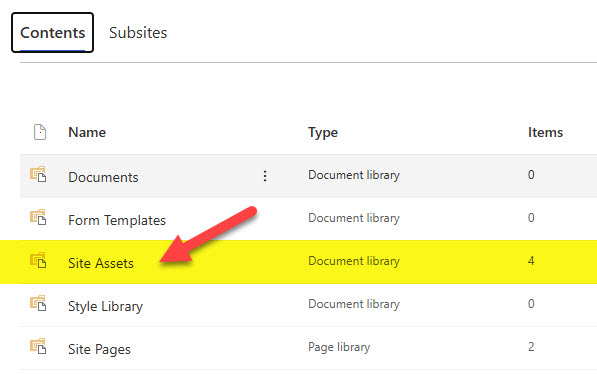
- You will see the contents of the Site Assets library. The image below depicts how the Site Assets library looks on a brand new SharePoint site.

What types of content are stored in a Site Assets Library?
The image above shows the contents of a Site Assets library right after the site was created. Of course, as you add content to the site, you should expect to see many more files and folders in there. Here is a breakdown of what you might see there.
1. Logo
Every time you upload/change the site/thumbnail logos, the logo images are stored inside the Site Assets library.

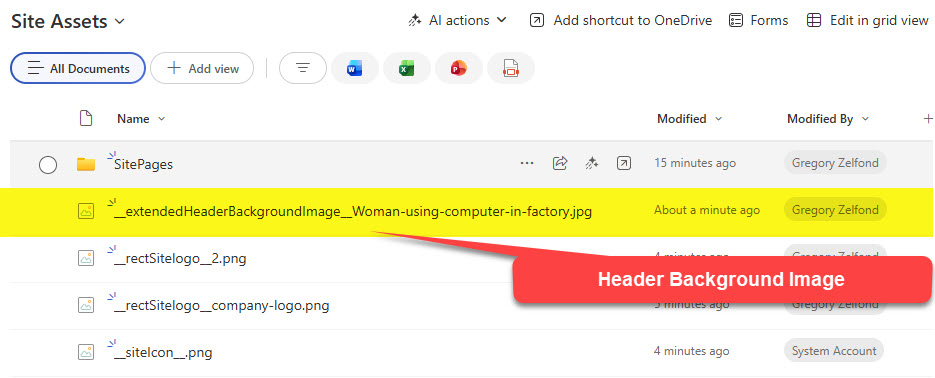
2. Site Header/Site Footer background image
If you upload a custom background image to the Header or Footer (Communication sites only), those images also reside in the Site Assets Library.
3. OneNote Notebook
This is only applicable to a Team Site, because once you create one, you automatically get a OneNote Notebook added to it. Guess where it is physically residing? You got it, Site Assets Library!

4. Images added to SharePoint Pages via Image Web Part
As you add custom images to your SharePoint pages, those images are physically added to the Site Assets Library as well. What is interesting is that it organizes them by the Folders that bear the names of the Pages.


5. Images added to SharePoint Pages via Image Gallery Web Part
The same applies when you add multiple images using the Image Gallery Web Part. Those images are stored in the folders with the same name as the SharePoint page.

6. Videos added to SharePoint Pages
If you decide to embed videos into your SharePoint pages, those video files are also residing within the Site Assets Library. Moreover, it does not matter whether you added a video via the File and Media Web Part or the Video Web Part.

7. Icons/Images for Quick Links Web Part
Another thing stored in the Site Assets Library are images/icons you upload for the Quick Links Web Part.

8. File and Media files
If you choose to embed Office files into the pages using the File and Media Web Part, those files will also be part of the Site Assets library!

9. Lists Excel Import files
If you decide to create a new list by importing an Excel document, that Excel file will be stored in the Site Assets Library. What’s interesting is that if you import a CSV, that file will not be stored in Site Assets.

10. Events Web Part banners
If you use the Events Web Part to manage and display a list of events for your organization, the images you upload as event banners are also stored in the Site Assets Library. What is interesting is that no matter what you name your event, the images are stored inside the folder called Event, Event(1), Event(2), etc.

11. Hero Web Part
If you use the Hero Web Part, the custom image you upload for the tile is stored in the respective page folder as well!

12. Editorial Web Part
The same is true for the Editorial Web Part – the image you upload as a background image will be stored just like the one for the Hero Web Part.
13. Countdown Timer Web Part
Countdown Timer Web Part is no different. The image you upload as a background image will be stored just like the one for the Hero Web Part.
14. Section Backgrounds
The custom images you can now upload as backgrounds to each page section are also stored inside the Site Assets library!
15. Copilot Agents
If your organization delved into Copilot, you might also see some custom agents in the Site Assets library. I explained how to create a Copilot Agent in this article. By default, it is stored in the same library as the source. However, once the Agent is approved, it is moved to the Site Assets library inside the Copilots > Approved folder.

Nuances about the Site Assets Library
- Though you can upload working documents inside the Site Assets Library, this would not be the right thing to do. That is why we have the Documents Library.
- You can only have one Site Assets Library per site
- OneNote Notebook won’t appear in the Site Assets library until someone accesses it at least once
- Images saved in the Site Pages folders within the Site Assets library are only those that are custom ones. If you choose stock images suggested by Microsoft, those won’t be saved.
- As you change logos, delete added images from the pages, and change them, the assets used for the old pages do not get deleted and remain inside the Site Assets library.
- While the Assets Library can be easily deleted, it would be a pretty stupid thing to do, as this would render the site unusable
- If someone deletes the Site Assets Library, a new one will be created as soon as any of the above steps occur (e.g., a new logo uploaded, a new page with an image created, etc.). However, all the pages created before that will not render or function (unless the Site Assets Library is restored from the Recycle Bin).

Share Article