IT or Business – who owns SharePoint?
I raised this question many times in the past, both on my blog and social media. And I think it is necessary to raise such discussions, because I still see a troubling trend out there with IT departments and Managed Service Providers (MSPs) still controlling all aspects of SharePoint from site and team creation to permissions management, and most of the collaboration settings like external sharing and OneDrive sync. Business users often end up sitting on the sidelines, waiting for IT to deliver what they need.
Business’s responsibility
To cut to the chase, I strongly believe that the Business should take ownership of SharePoint. By ownership, I mean the overall responsibility/ownership for the content/data creation, integrity, and access. And I do not mean at all that IT should be ignored and completely eliminated in the process. In contrast, the Business should work with the IT department to enable some processes and control them through proper governance and setup.
Next, let me now provide some arguments in favor of this new model.
Reason #1: The Site is the new “folder.”
In the old days, IT would create a folder on a network drive, configure its permissions via Active Directory groups, and Business would take it from there. Well, the site is the new folder, my friends. And not just the site! If we are talking about a Team Site, that means there is a Microsoft 365 Group attached to it, along with Team, Planner, and a group calendar! And the permissions for the group can be easily managed by the group owner, without IT’s involvement or AD groups!

Reason # 2: Channels are just additional folders and sites
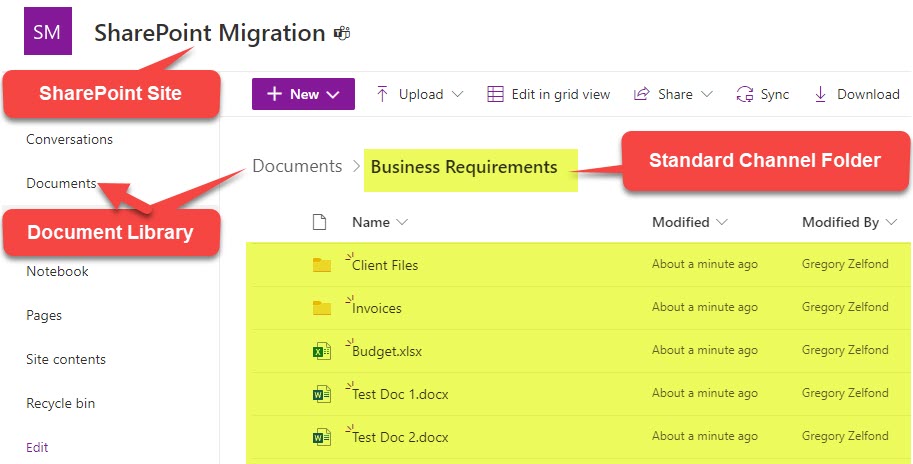
To add to the above arguments, when business users create additional channels in Teams, they either create folders or additional sites, depending on the channel type. That means more content and more management by business users.
Reason # 3: Non-document content
It is not all about files and folders. When on a site, users can create lists. They can also create content using other Microsoft 365 applications. They can create intake forms, surveys, and quizzes in MS Forms; chat in Teams; send emails in Outlook; create tasks in Planner; and hold conversations in Viva Engage. In other words, content comes in all shapes and sizes. Most of it does not require IT’s involvement, as all of the content mentioned above can be easily managed via Microsoft 365 Group membership and by users/Team Owners.
To summarize, Business is responsible for the following tasks:
- Content creation
- Content permissions
- Content integrity
- Content quality
- Content sharing (internal and external)
IT’s responsibility
In contrast, IT should act as an enabler, focusing on platform reliability, security, governance, and guardrails rather than day-to-day ownership.
- SharePoint Admin Center settings
- Hub Creation and Management
- Data backup
- Data Archival
- Version Management/Storage
- Entra ID Security Groups
- Advanced Management (reporting)
- Overall Governance
- Set up Boundaries and guard rails for usage
Additional Thoughts about IT vs. Business owning SharePoint
- A RACI chart might help set up proper responsibilities
- With many of my clients, especially those using MSPs, I recommend having internal business users who serve as SharePoint champions. Having access to the SharePoint Admin Center, so they can easily enable certain settings on sites without bureaucracy, like external sharing on sites
- With ownership comes the ultimate responsibility – that means proper training for both the business and its users is a must!

Share Article